
Pet urine is the single most common problem behind the calls we get — and the one surrounded by the most bad advice. After 20 years of cleaning carpets across Maryland, we’ve seen every DIY approach walk through the door ahead of us: vinegar and baking soda, store-bought sprays, rented steam machines, even bleach. Most of them share the same flaw — they treat the spot you can see, while the actual problem sits two layers down where nothing you can buy at a grocery store will reach it.
This guide explains what pet urine actually does inside carpet, which home treatments genuinely help (a few do), why some popular fixes make things permanently worse, and what professional removal involves when the smell keeps coming back. Updated July 2026.
What Urine Actually Does Inside Carpet
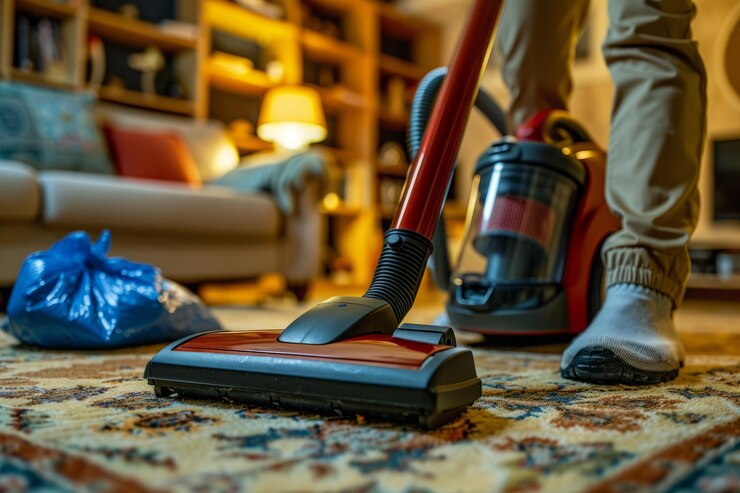
A pet accident isn’t a surface stain — it’s a liquid event that follows gravity. Urine hits the pile, soaks through the backing, saturates the padding underneath, and in repeat-accident spots can reach the subfloor. The visible spot on top is typically the smallest part of the contamination; urine spreads outward as it soaks down, so the affected area in the padding is usually wider than what you see on the surface.
Then chemistry takes over. Fresh urine is mildly acidic, but as bacteria break down the urea it turns alkaline and forms urine salts that bond to carpet fibers. Those salts are hygroscopic — they pull moisture out of the air — which is exactly why the odor gets stronger on humid Maryland days. A spot that seems fine all winter and reeks every July isn’t your imagination; it’s urine salt in the padding reactivating with summer humidity.
What Actually Works: Enzymes
Urine is organic material, and the only chemistry that genuinely eliminates it — rather than masking or partially dissolving it — is enzymatic. Enzyme cleaners use bacteria-produced proteins that digest the urine compounds themselves: protease breaks down the proteins, lipase handles the fatty compounds, and amylase works on the starches. When the organic material is gone, the odor source is gone — not covered, gone.
This is the same chemistry class we use professionally. Our enzyme pet-and-stain treatment (a bacterial protease/lipase/amylase formula) is included in every $199 package — not sold as an add-on — and gets a 15–30 minute dwell time on urine zones before extraction, because enzymes need working time to digest the material. Spray-and-immediately-blot defeats the whole mechanism, which is the most common reason store-bought enzyme products “don’t work”: they weren’t given time to.
The Fresh-Accident Playbook (Do This First)
- Blot, don’t scrub. Press clean towels into the spot with real weight — stand on them — and keep swapping until they come up nearly dry. Every ounce you pull out now is an ounce that never reaches the padding. Scrubbing spreads the urine sideways and frays the pile.
- Apply an enzyme cleaner generously. The cleaner has to go everywhere the urine went, which means saturating slightly beyond the visible spot. Test any product on a hidden area first.
- Give it real dwell time. Follow the label — typically 15 minutes minimum for a fresh spot, and covered with a damp cloth for hours on an older one. This is the step everyone skips.
- Blot again and let it dry fully. Keep pets off the spot while it dries — the smell of a half-treated accident invites a repeat visit to the same location.
Done promptly, this genuinely resolves many single fresh accidents. Where it stops working is depth and repetition — which is most of what we get called for.
What Makes It Worse
- Uncontrolled heat on an untreated stain. Hitting a urine spot with a rental steam machine before the proteins are broken down can bond them to the fiber — effectively cooking the stain in. Heat belongs at the extraction stage, after enzyme treatment, not before it.
- Baking soda mountains. Baking soda absorbs some surface odor, but piled into carpet it filters down and cakes at the base of the pile, where it holds moisture against the backing. We extract gray baking-soda sludge from pet spots constantly.
- Fragrance-heavy sprays. Masking products don’t remove the urine salts — and your pet’s nose isn’t fooled either. The spot stays marked territory.
- Ammonia-based cleaners. Urine breaks down into ammonia compounds; cleaning with ammonia smells like more urine to a pet and can encourage re-marking.
- Bleach. It doesn’t digest the organic material, and it will take the carpet’s color with it.
When It’s Beyond DIY: What Professional Removal Involves
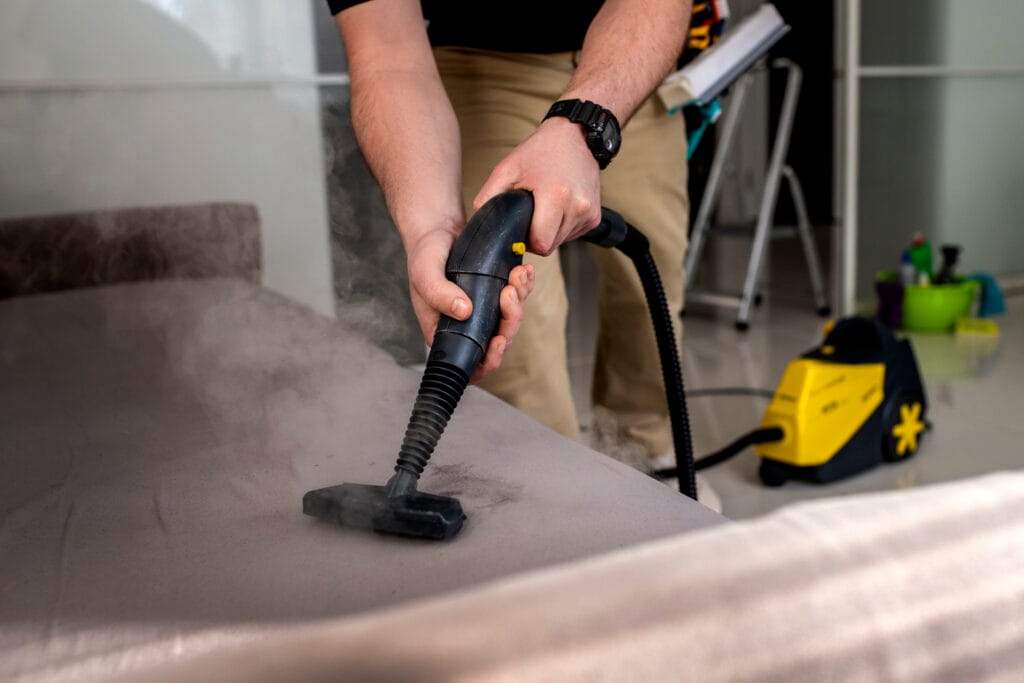
If a spot has been hit more than once, if the odor returns on humid days, or if you can smell it but can’t find it — the contamination is in the padding, and surface treatment can’t resolve it. Here’s what our process does differently:
- Locate every deposit. Urine zones get identified and mapped before any chemistry goes down — including spots the homeowner didn’t know about.
- Enzyme treatment with enforced dwell. The bacterial enzyme formula goes on every affected zone and gets its full 15–30 minutes of working time while the rest of the job proceeds.
- Truck-mounted hot water extraction. Our Diamond Products GTXR+ and TCS Chief II systems flush the digested material out at 220°F with vacuum lift that pulls from the padding layer — not just the pile. This is the step no rental machine replicates, and it’s why the odor doesn’t come back with the humidity.
- Controlled drying. Air movers positioned before we leave; carpet dry to the touch in 2–4 hours.
All chemistry is Green Seal GS-37 certified — independently verified, EPA-recognized — which matters in exactly the homes that have pet accidents: the ones where pets and kids live on that carpet daily. The deep-clean mechanics are covered in our complete hot water extraction guide.
The Honest Limit: When Padding Has to Go
There’s a point past which no cleaning — ours included — solves a urine problem: padding that has been saturated repeatedly over months. Padding is foam; it holds urine like a sponge holds water, and once it’s loaded deeply enough, extraction from above can’t fully clear it. In those cases the honest fix is pulling the carpet back, replacing the padding section, treating the subfloor, and relaying the carpet. We tell homeowners this up front when an inspection shows that’s the situation — selling a cleaning that can’t fix the problem isn’t a service, it’s a delay.
Frequently Asked Questions
Why does the pet urine smell come back on humid days?
Urine salts left in the padding are hygroscopic — they absorb moisture from humid air and reactivate. Removing the salts (enzyme treatment + deep extraction) removes the seasonal cycle.
Do enzyme cleaners really work better than regular carpet shampoo?
For urine, yes — shampoo lifts soil but doesn’t digest the organic compounds that cause odor. Enzymes eliminate the source. The catch is dwell time: they need 15+ minutes of working time, which most people don’t give them.
Is pet odor treatment an extra charge?
Not with us — the enzyme pet-and-stain treatment is included in our $199 three-area package. Many companies price it as a $60–$100 add-on; ask before booking anyone.
Can old, dried urine stains still be removed?
Usually, yes — dried deposits take longer enzyme dwell and thorough extraction, and repeat-accident zones may need more than one pass. The exception is deeply saturated padding, which needs replacement rather than cleaning; we’ll tell you which case yours is after inspecting it.
Will the treatment stop my pet from re-marking the same spot?
It removes the scent marker that draws pets back — that’s the biggest factor. Full enzyme digestion of the deposit means there’s nothing left for their nose to find.
If the problem furniture is a couch rather than the carpet, the same enzyme-first logic applies — see our guides to cleaning urine out of a mattress and whether carpet cleaning kills fleas for the related battles pet owners fight. And when you’re ready for the professional pass: our crews handle carpet cleaning in Bowie, plus jobs in Severn and Perry Hall, most weeks.
Did the accident reach a couch or chair? Xtreme Cleans handles accepted synthetic upholstery cleaning only; send the care label, fiber line, and photos first because leather, wool, linen, silk, velvet, viscose, and rayon are outside scope.
Ready for a real answer on your carpet cleaning?
Text a photo of the problem to (410) 819-2223 and we’ll reply in minutes — or call for same-week availability across Maryland.
