
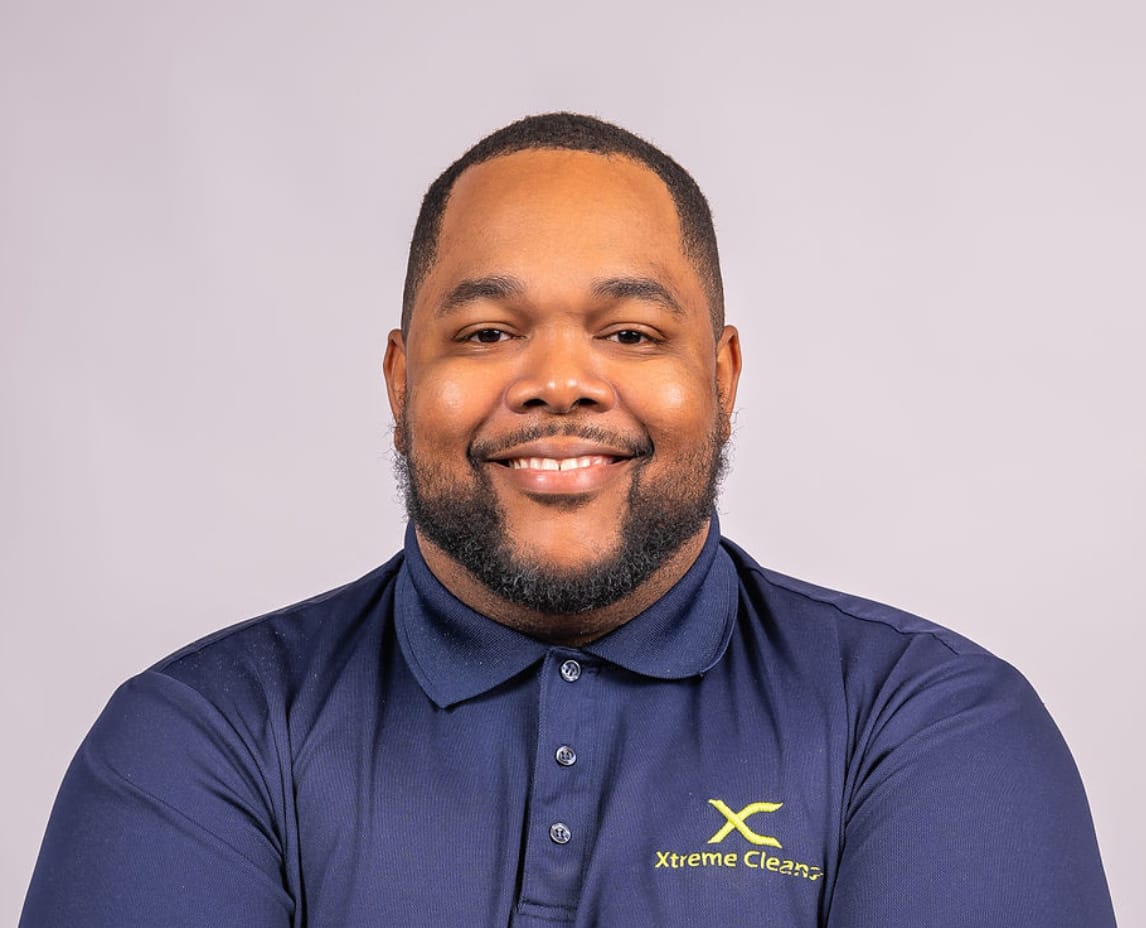
By Lee Hughes · Published November 22, 2026
Professional upholstery cleaning runs in four stages: inspect the fabric and its cleaning code, remove dry soil and pre-spray, agitate and extract with a rinse, then groom and dry. Synthetic upholstery is dry in 2 to 4 hours.
Upholstery cleaning is the on-site cleaning of fabric-covered furniture such as sofas, sectionals, armchairs, dining chairs and ottomans. A cleaning code is the letter on the furniture tag that says which cleaners the fabric tolerates, and that letter decides whether a fabric is wet-cleaned at all. Xtreme Cleans, a family-run Maryland company since 2014, cleans synthetic upholstery across 12 Maryland counties. This guide sets out the order of the work, the reason behind each stage and the fabrics the process is not used on.
What are the steps of professional upholstery cleaning?
Professional upholstery cleaning has 4 stages: inspect and test the fabric, remove dry soil and pre-spray, agitate and extract with a rinse, then groom and dry. The fabric is tested in a hidden spot for colorfastness before any cleaner touches the visible surface.
Each stage prepares the fabric for the next one. Xtreme Cleans runs the same 4 stages on every synthetic piece it cleans, and the page on upholstery cleaning in Maryland covers pieces, prices and booking.
- Inspect and test. The crew identifies the fabric, reads the cleaning code and tests a hidden area for colorfastness. Colorfastness is a dye's resistance to bleeding or fading when a cleaner touches it. Furniture makers ask for the same check: Bernhardt's care instructions say "Pretest a small, inconspicuous area before proceeding," and La-Z-Boy asks for a pretest on a small, inconspicuous area first. The test comes first because a dye that moves on a hidden seam would move on the seat cushion too. If the fabric is not one Xtreme Cleans cleans, the customer is told before any treatment.
- Remove dry soil and pre-spray. Loose dust, crumbs and hair come off while the fabric is still dry. Bassett notes that dust left in upholstery can cause abrasion, the slow wearing of fibers by grit. The pre-spray is a cleaning solution misted over the fabric to loosen body oils and general soil. Xtreme Cleans uses Green Seal GS-37 certified cleaning chemistry, which is biodegradable. Spot pre-treatment of individual stains depends on the stain and the fabric.
- Agitate, extract and rinse. A soft brush works the solution into the weave so it reaches soil held in the yarns. Truck-mounted hot water extraction then flushes the fabric and pulls the solution and the loosened soil back out. A pH-balanced rinse follows, so cleaning solution is not left behind in the fabric. Controlled passes keep the fabric from being soaked; Ashley prints "Do not over wet" under its W code, and La-Z-Boy prints "Do not saturate."
- Groom and dry. Grooming means brushing the surface in one direction so the nap, the raised surface of the fabric, lies evenly as it dries. Ashley notes that pile fabrics may require brushing to restore their appearance. Cleaned synthetic upholstery is then dry in 2 to 4 hours.
How does the cleaning code decide the method?
The cleaning code sets the limit: W allows water-based cleaners, S allows only a water-free solvent, WS allows either, and X allows vacuuming or light brushing only. The maker's own care instructions can narrow that limit further for a specific fabric.
The tag usually sits under a seat cushion or on the deck, the platform the cushions rest on. Four letters cover almost every piece:
| Code | What the maker allows | Maker wording |
|---|---|---|
| W | Water-based shampoo or foam upholstery cleaner | Ashley: "Clean only with water-based shampoo or foam upholstery cleaner." |
| S | A water-free dry-cleaning solvent only | Ashley: "Do not use water." |
| WS | Upholstery shampoo, mild detergent foam or a mild dry-cleaning solvent | Ashley: "Do not saturate with liquid." |
| X | Vacuuming or light brushing only | Bernhardt: "DO NOT USE ANY WATER OR SOLVENT BASED CLEANER." |
Each letter is set out in full in what the W, S, WS and X codes mean.
The code is not the whole answer. La-Z-Boy's care page says hot water extraction or steam cleaning is not recommended for its W-coded fabrics, and Bassett prints the same sentence under its WS code. Crypton, a performance-fabric maker, takes the opposite line for its own fabric: it recommends hot water extraction with hot water only and no cleaning solution, because soap can attract more dirt over time.
That is two makers, two fabrics and two answers. The letter on the tag says which cleaners a fabric tolerates. The maker's care sheet says whether a machine method suits that fabric. Hot water extraction does not suit every synthetic fabric, and the care sheet is the document that settles it for a given piece. Keep the care sheet or a photo of the tag, and share it when you ask for a quote. If a fabric is not one Xtreme Cleans cleans, the customer is told before any treatment.
La-Z-Boy also draws a line between spot cleaning and overall cleaning. For S-coded fabric it recommends overall cleaning by a professional furniture cleaning service only, and for W-coded fabric it points to a professional once an overall soiled condition has been reached. For a single spill rather than a whole piece, see the guide to removing a stain from upholstery.
Why does upholstery need a rinse after extraction?
Cleaning solution left in the fabric holds new soil, so the piece looks dingy again sooner. A rinse removes that residue, and controlled extraction keeps the fabric from being soaked, because oversaturation can cause water rings.
Once the code has cleared a water-based method, the next question is what stays behind in the fabric. Residue is cleaning solution that dries in the weave instead of leaving with the soil. Crypton states the problem directly: "soap residue attracts dirt and can make your fabric look dingy." Its own hot water extraction advice uses plain hot water for the same reason. The rinse stage exists to carry residue out, and Xtreme Cleans follows extraction with a pH-balanced rinse.
Water is the second risk. Crypton warns, "Avoid soaking the fabric. Oversaturation can cause water rings." A water ring is the visible outline left where moisture spread through the fabric and dried. Furniture makers print the same caution on almost every code: Ashley's "Do not over wet" for W, and "Do not saturate" for S and WS. Upholstery fabric is stretched over padding and a frame, so the goal is to put in only as much water as extraction can take back out.
Carpet gets a similar sequence on a different structure, with a pad and subfloor beneath it instead of a cushion and frame. The carpet guide explains how the carpet process differs.
When can you use the furniture again?
Cleaned synthetic upholstery is dry in 2 to 4 hours. Fans or a dehumidifier in the room shorten the wait, and the EPA advises keeping indoor humidity below 60 percent, ideally between 30 and 50 percent.
The EPA's mold guidance sets the outer limit. For wet upholstered furniture, it says water should be removed with a water-extraction vacuum and that fans and dehumidifiers can speed drying. It adds that in most cases mold will not grow if wet or damp items are dried within 24 to 48 hours. That window is EPA guidance for water-damaged items, not a cleaning dry time, and a 2-to-4-hour dry sits far inside it.
Run a dehumidifier or fan in the room and test the seat by hand before sitting down.
Keep pets in another room or crated during the visit, and keep them off the fabric until it is dry.
Which upholstery is the process not used on?
Xtreme Cleans cleans synthetic fabrics only. Leather, faux leather, wool, linen, silk, velvet, viscose, rayon, acetate and triacetate are declined. Separately, a maker's X code allows vacuuming or light brushing only, whatever the fiber.
Synthetic upholstery is fabric made from manufactured fibers. The fabrics cleaned are polyester, microfiber, olefin (polypropylene), nylon and most synthetic blends. The declined list:
- Leather and faux leather
- Wool, linen and silk
- Velvet
- Viscose and rayon
- Acetate and triacetate
The X code is a separate limit that applies to any fiber. Ashley's wording is "Do not clean with either water- or solvent-based cleaner. Use vacuuming or light brushing only." Bernhardt specifies light brushing with a non-metallic, soft bristle brush. Bassett warns that water-based foam or solvent cleaners on X fabric may cause excessive shrinking.
To check a piece before asking for a quote, read the tag under the cushions or on the deck, then the paperwork from the sale. If neither names the fibers, the retailer or the maker can. The list of questions to ask an upholstery cleaner covers what else to settle before a visit.
Xtreme Cleans prices upholstery by the piece: $125 for a loveseat, $149 for a sofa, $249 for a sectional, $25 for a dining chair and $50 for an ottoman, with a $199 minimum per visit. Spot pre-treatment depends on the stain and the fabric, and pet-urine treatment on upholstery is charged separately. The page on couch cleaning covers sofas and sectionals in detail. The quote form below this guide returns a free written price the same working day, with no obligation, and the team answers Monday through Sunday, 8 AM to 10 PM.
Upholstery cleaning process questions
Is upholstery cleaning the same as steam cleaning?
Furniture makers use the two names together: La-Z-Boy and Bassett both write "hot water extraction or steam cleaning" and say it is not recommended on certain W and WS fabrics. Xtreme Cleans uses truck-mounted hot water extraction, so check the tag and the care sheet to see what the maker recommends for a piece.
Does the crew test the fabric before cleaning it?
Yes. The fabric is identified and tested in a hidden area for colorfastness before anything is applied to the visible surface. Furniture makers ask for the same step, and Bernhardt's care instructions say to pretest a small, inconspicuous area before proceeding.
What happens if a fabric cannot be wet-cleaned?
An X code on the tag allows vacuuming or light brushing only, so bring the care sheet or a photo of the tag with your quote request. A fiber outside the synthetic list is declined, and the customer is told before any treatment begins.
Does upholstery cleaning include pet urine treatment?
No. Pet-urine treatment on upholstery is charged separately from the per-piece price, and the amount depends on how severe the contamination is. Mention pet accidents when you ask for a quote so the written price can account for them.
Can a dining chair or ottoman be cleaned on the same visit?
Yes. Either can be added to a sofa, loveseat or sectional on the same visit, at $25 for a dining chair and $50 for an ottoman. Upholstery visits carry a $199 minimum per visit, so a visit for small pieces alone is billed at least $199.