
If you manage rental units in Maryland, carpet is one of your most predictable recurring costs — and one of the easiest to get burned on. Turnover windows are short, month-end demand spikes are brutal, and the difference between a carpet that survives another tenancy and one you’re replacing at $2+ per square foot often comes down to who cleaned it and how. Since 2014 we’ve cleaned 900+ buildings across Maryland — apartment communities, offices, and retail for national brands — and this guide covers what property managers actually need to know about apartment turnover cleaning in Maryland: turnover timing, cleaning vs. replacement calls, common-area programs, and what to demand from any vendor before they touch a unit. Updated July 2026.
Apartment Turnover Cleaning: Why Timing Beats Price
Leases end at month-end, which means the last week of every month — and the entire May-through-August stretch in Maryland — is when every property manager needs the same vendors at once. A carpet cleaner who can’t hold capacity in those windows costs you vacancy days, and vacancy days cost more than any cleaning invoice.
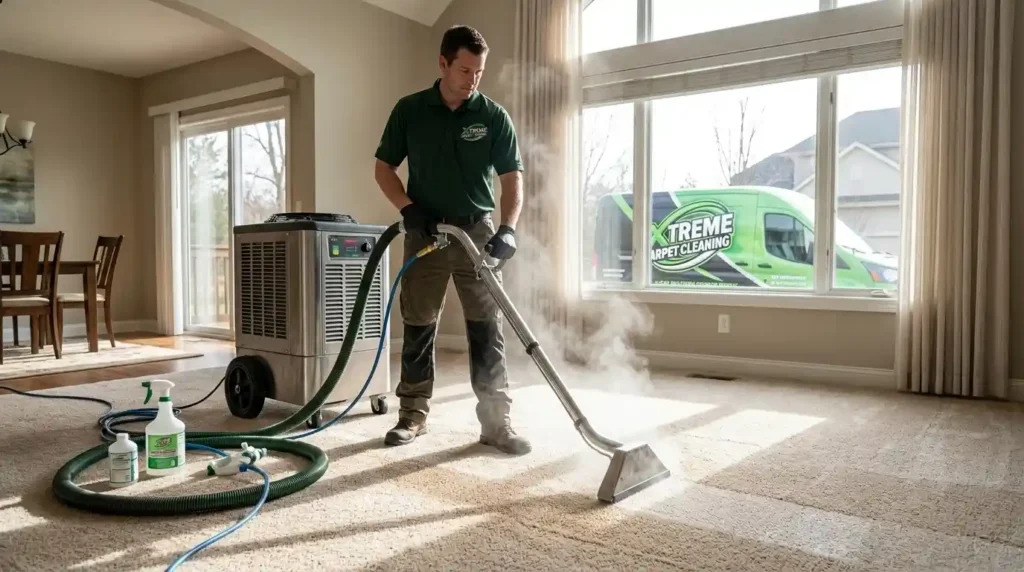
Two things matter more than the per-unit rate here. First, scheduling reliability: we run same-week scheduling as the norm and can work units in sequence as they clear inspection, rather than making you batch everything into one fixed date. Second, turnaround inside the unit: our truck-mounted process leaves carpet dry to the touch in 2–4 hours, which means painters, maintenance, or showing agents can be in the unit the same day — not tomorrow.
Clean or Replace? The Call That Saves Real Money
The most expensive habit in unit turnovers is replacing carpet that a proper deep clean would have saved — and the second most expensive is repeatedly cleaning carpet that should have been replaced. After 900+ buildings, here’s how we frame the call:
| Condition | Right Call | Why |
|---|---|---|
| Traffic-lane graying, general soil, most stains | Clean | Compacted soil and typical staining extract fully with hot water extraction — this is the majority of “worn-looking” turnover carpet |
| Pet odor, scattered accidents | Clean with enzyme treatment | Bacterial enzyme treatment + deep extraction removes the source; included in our pricing, not an add-on |
| Urine-saturated padding (repeat soaking) | Partial: replace padding, clean carpet | Padding holds urine like a sponge; carpet above it is often salvageable at a fraction of full replacement |
| Delamination, burns, olefin worn flat | Replace | Structural damage doesn’t clean out — we’ll say so instead of billing you for a cleaning that won’t pass inspection |
That last row is the one to test a vendor on. A company that never tells you “this one needs replacement, not cleaning” is billing you for failures. The honest assessment is the same one we give homeowners — it’s why clients keep calling since 2014.

Common Areas: the Program, Not the Panic Call
Hallways, lobbies, stairwells, and leasing offices take more traffic per square foot than any unit — and they’re the first thing a prospective tenant sees. The economics favor a schedule over emergencies: quarterly or semi-annual common-area cleaning holds appearance at a predictable line-item cost, while panic cleanings before an inspection or ownership visit cost the same money for worse results on carpet that’s been left to compact for a year.
We schedule common-area work around building life — evenings and weekends included — with hose runs managed so entrances stay usable. For multi-building communities, walk-through pricing puts the whole property on one predictable schedule with volume rates.
The Maryland Turnover Calendar
Turnover demand in Maryland follows the lease cycle with almost no variation, and planning against it is worth real money:
- Last week of every month: the recurring crunch — leases end, units clear, everyone calls the same vendors. Standing arrangements beat one-off bookings here.
- May through August: peak season — student moves, family moves timed to school years, and military rotations around Maryland’s bases stack on top of normal churn. Lock vendor capacity in early spring, not in June.
- September–October: the recovery window — the right time to schedule common-area programs, while crews have room and before holiday traffic hits lobbies.
- Winter: the quiet months — best availability for whole-property catch-up work, and salt season is when entrance-adjacent carpet takes its worst beating.
What Apartment Turnover Cleaning Costs Per Unit
Turnover carpet is priced by area, not by bedroom count — which is why any quote given over the phone before someone has seen the unit tends to move afterwards. Our published rate is $199 all-inclusive for three areas, with volume pricing across a portfolio.
How many areas your units come to depends on layout, stairs, and how the closets and hallways are counted, so we won’t publish a per-bedroom table that would only be wrong for your building. Call or text (410) 819-2223 with your unit mix and we’ll give you a real per-unit number — and hold it across the portfolio.
Pet treatment and deodorizer are included rather than billed as add-ons, which is what makes turnover costs predictable across a portfolio instead of arriving as a surprise line item. For the full breakdown of what moves carpet cleaning pricing in Maryland, see our carpet cleaning cost guide.
What to Demand From Any Carpet Vendor
- Certificate of insurance, before work starts. We carry a $4 million ERIE umbrella policy (general liability + workers’ comp) — COI provided on request, every time. Never let an uninsured crew into an occupied building.
- Truck-mounted equipment. Portable-unit vendors leave units damp into the next day — that’s your make-ready schedule slipping. Ask which they run before comparing prices; our hot water extraction guide explains the difference.
- All-inclusive line items. Pet treatment and deodorizer billed as add-ons make turnover costs unpredictable. Ours are included ($199 for 3 areas residential-equivalent; volume pricing for portfolios).
- Screened, uniformed technicians. Your crews are inside tenants’ buildings under your name. Ours are background-checked and trained in-house.
- Safe chemistry on record. Green Seal GS-37 certified (EPA-recognized eco-label) — an easy answer when a tenant with kids, pets, or allergies asks what was used in their unit.
Frequently Asked Questions
How fast can a unit be back in the make-ready sequence after carpet cleaning?
Same day — carpet is dry to the touch in 2–4 hours with our truck-mounted process, so afternoon trades or showings can follow a morning cleaning.
Do you handle pet-damage units?
Yes — enzyme treatment is part of our standard process, and where padding is beyond saving we’ll recommend sectional pad replacement rather than billing repeat cleanings that can’t fix it.
Can you service multiple units or buildings on a schedule?
Yes — that’s most of what our commercial work looks like. Volume pricing applies, and we hold capacity for recurring clients through the month-end and summer turnover rushes.
Do you provide documentation for owners and inspections?
COI on request before any job, and per-visit invoicing that itemizes what was done in which unit — the paper trail your owner reports need.
How much does carpet cleaning cost for a 2-bedroom apartment?
Our all-inclusive rate is $199 for three areas, with pet treatment and deodorizer included rather than billed on top. Whether a given 2-bedroom comes to three areas or more depends on its layout, so call or text us with the unit and we’ll quote it properly.
What about offices and retail, not just residential?
Both — our commercial history includes national retail brands, and we schedule around business hours so the space is never closed when customers expect it open.
For the building-wide picture beyond carpet, see our apartment building cleaning guide. Our crews already run turnover routes through Maryland’s apartment-dense corridors — White Marsh, Towson, and Clinton among them.
Managing units across Maryland?
Text a photo of the problem to (410) 819-2223 and we’ll reply in minutes — or call to set up portfolio scheduling and volume pricing.
